This is the second of two posts. The first set out what the research says and where we’ve landed on when students use AI; this one is about integrity.
What happens when we find that a student has submitted work that was written by AI?
There’s a short answer to that question – one about consequences. There’s also a much longer, broader one. The short answer comes first, but I want to spend the bulk of this post considering the broader one.
The short answer: We take this seriously. For a first instance, it is usually a learning experience: we aim to work with the student to put it right rather than punish, and most cases end there. Where it is repeated, or where the stakes are higher, the consequences escalate: firmer conversations and supervision, no award of a grade, meetings with parents, suspension, and in serious cases, or after repeated offences, we ask a student to leave the College. Where that scale bites depends on the case. It matters whether the student is in Middle School or High School, whether or not the work was for external IB coursework, and whether or not the student was honest when called to account. We also take extenuating circumstances – a bereavement, say – into account.
Now the broader answer. What is familiar is that cheating predates AI: schools play whack-a-mole and will keep playing it, even though no school ever catches all of it, any more than schools ever caught everyone copying from a friend. What is new is that AI makes it effortless, and increasingly good. Copy from the person at the next desk and you often copy their mistakes; but AI writes well, and can sound like you. So there are two worries for parents – that their own child will be tempted, or that their own child’s honesty will mean they suffer if others cheat. I’ll address both here.
Our students are not bad children – any more than I was (I remember my friend Terry Baxter, who used to share his homework with me one week, as long as I would share mine with him the next week. When we were caught, the teacher gave us 50% of the mark each, which seemed reasonable at the time). I say that not to excuse myself but to stop us from being shocked. A capable, decent, tired sixteen-year-old with a deadline who makes a bad decision is not a villain. Our own students are candid about this in surveys. One summed it up as “Pressure = AI Use”.
So how do we guard against malpractice, and how well can we do it in an AI age?
Let me start with what we cannot do. Nobody – not us, not the IB, not the companies that sell detection software – can look at a finished piece of work and establish for certain whether, or how much, AI was used in producing it. Nor can we rule out AI use across the whole of a piece of coursework developed over months, much of it at home. There is no point in pretending otherwise. So what can we do?
We have many years’ experience of this. There are four checks: that the teacher has watched the work develop over time rather than appear in one evening; that the student can explain it; that they are clear about what is quoted and what is theirs; and that the finished piece is in line with what that student could be expected to produce. Those checks are why coursework involves regular conversations between student and teacher, and AI has put some of them under strain – “what this student could be expected to produce” is harder to judge when a tool can write in anyone’s style. But the checks still remain very useful, because we know the kids and we see where they cannot explain or justify, or where an essay appears from nowhere. And if you look at them, you can see that the checks have a rather different focus from detecting AI use: they tell us whether students have learnt. A student who can talk fluently about why they chose that question, what went wrong in the method and what they would do differently has done the thinking. A student who can’t, hasn’t – and that matters whether or not AI was involved. So even if we cannot honestly claim to detect AI, we are claiming to know the child, and to know whether the child has learnt.
Our students, interestingly and reassuringly, seem to want exactly this when asked what would help most with authentication. Their two commonest requests were subject-specific clarity on what’s permissible, and more check-ins as the work develops. One asked teachers to be “personally asking me questions and discussing if they have concerns – allowing me the opportunity to demonstrate that I am knowledgable about the work that I have produced.” They also told us last year where we have work to do: a little over three-quarters said they had gone through the guidelines in class, and only about two-thirds had yet practised citing AI properly. We’re on it.
So, how can parents help and reinforce the school’s goals? The most useful thing a parent can do here is to ask questions that make work visible: What did you actually find difficult about that? What did you decide to leave out? Explain that bit to me. Those are the sorts of questions we ask our students; and like us, you may occasionally get a shrug, or be rebuffed. But the effort to ask questions teaches the student something, and even a failed attempt tells a parent something. Students who can properly answer questions like those have done the work. Students who can’t will discover that quickly, at home, with you, or in class with us. And then something can be done, rather than waiting for the stark reality of the examination hall.
A further (also partial) protection is that in most subjects coursework sits alongside final examinations, which carry the larger share of the marks: 70–80% in the sciences, maths and humanities. A student who gets plagiarised coursework past us won’t have learnt much, and in those subjects that will show up in the exam hall. It is a weaker protection in languages, where coursework counts for more, and none at all in non-exam subjects, where we rely more heavily on teachers’ knowledge of the student and of how the work has developed.
Nor is the school the last line. The IB runs its own checks on the work submitted to it, and examiners flag what looks wrong to them; every year thousands of cases go to senior examiners for exactly that scrutiny. I know, because for many years I chaired the IB’s annual Academic Integrity committee, and the IB sees the same picture from where it sits: its Director of Assessment also lists essay mills, external tutors and family members as issues. The IB has updated its academic integrity policy with specific guidance on AI, and says openly that its programmes and assessment practices will need to evolve as these tools improve. Where the IB establishes misconduct, the penalty is no grade in that subject – which means no Diploma.
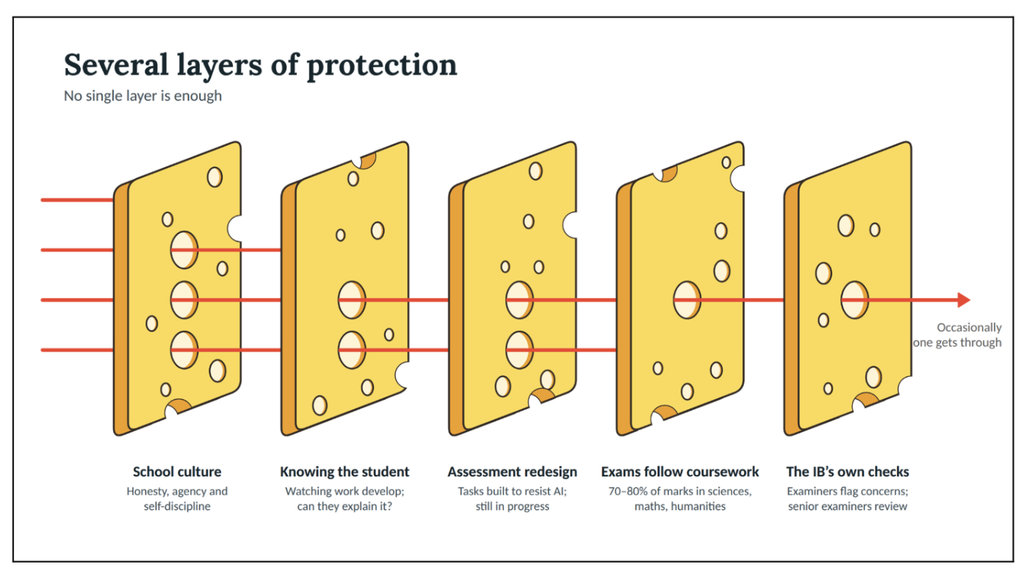
We don’t want academic malpractice and I’d love to tell you that we can always prevent it, but we can’t We have always had ways to work with students who cut and paste, copy from each other, copy from other schools, hire tutors, or even get their parents to write these things for them, and we know where the weak points are. Our Swiss cheese model relies partly on school culture, partly on knowing the student, partly on assessment redesign, partly on exams following coursework, and partly on the IB’s own checks. None of those approaches alone is sufficient; together, they are significant protection.
How this fits into our wider approach
It is a fact of life that some children will make mistakes of academic integrity and meet the consequences; this is nothing new. Working things out and learning to do better is, in the end, what school is for. The consequences of such a mistake have to be real enough to bite, but not so heavy that they demotivate, cause fear or cause gaming; and we need to let them make the mistakes early – Grade 9 is a lot better than Grade 12. So the gradient of AI entry provides time to deal with problems in good time. Our approach sits squarely within our long-established ways of dealing with poor behaviour. We foreground self-discipline, agency and ethical behaviour – which is to say, the long-term skills and dispositions (as well as monitoring, not instead of it). We’ve found that’s the more effective way to do it. As adults, we do not refrain from theft just because we may be caught, and any education which says don’t steal, because you might be caught, would be missing the point – though we do want people to believe that they will be caught. The aim is that students do the right thing because it is good for them and good for everyone around them. It is the same judgement we make about honesty, about kindness, and about how students treat each other when no adult is watching.
That is also why we treat using AI as an ethics issue, and as a skill to be taught across the gradient of AI use, not as a rule to be followed. Several of our students made the same point unprompted: teach us how to use it, rather than simply telling us not to. One observed that “if we focus more on providing information on how to cite AI and destigmatize its use, people will start to be more transparent” – which is, I think, right.
We also believe our approach avoids the familiar game of students spending a lot of effort to hide what they’re doing, rather than just doing it better in the first place. It’s real in a school like ours, where students are able and the stakes feel high. We do not want to end up in a pointless arms race.
For example, the once-popular ‘Draftback’ tool records the pace at which an essay is written, so that a pasted AI essay shows up as a single implausible event. An enterprising student then wrote an app that overcomes this by typing an AI essay out over several days, with backtracks and deleted paragraphs.
Detection tools are not, furthermore, entirely reliable. The best current ones claim to be far more accurate than the early ones, but even a rare false accusation against a child is serious, and there is a new unfairness: a student who writes their own essay and tidies it with an editing tool such as Grammarly may look more suspicious than one who had AI write it and then disguised it. Our students feel this keenly. “Just because we use advanced words doesn’t mean we used AI,” wrote one; “AI detectors are scary even if you dont use ai because of good writing,” wrote another. So even if we wanted an arms race, we aren’t sure we can trust our weapons. Even the companies that sell detectors say a result should start a conversation with the student, not settle the question – and that conversation is what we already have.
But the biggest issue would be turning teachers into policemen suspecting every student – changing the relationship between adults and students in damaging ways. MIT reached the same view in August, recommending against relying on detectors for that very reason. A detector might look like one more slice of cheese, but a slice that makes teachers suspicious of every student weakens the two we rely on most: school culture and knowing the student. And so what I worry about most: children who today love school, and learning, will no longer do so if they feel the teachers no longer trust them and are there to catch them out.
None of this is easy; there’s no magic bullet and it requires attention from both students and teachers. This is why our work is about accountability on both sides; teachers for how the work is set and supervised, students for ensuring the work is theirs. That includes being clear about teachers’ own use of AI – especially in giving feedback. Our goal is for teachers to know their students, to help them see why the work matters and enjoy it, so that they want to do the work and mostly don’t reach for the shortcut. That relationship is one of the central things we believe makes this the school it is, and, I hope, part of why our parents chose it. We all share the same goal of trying to form people who will be doing this well right across their future lives, not just making it through High School.
References
- Graphics by Claude and Gemini
- Glanville, Matt (2023) Why ChatGPT is an opportunity for schools, International Baccalaureate, 28 February 2023, first published in The Times
- International Baccalaureate (2023) Statement from the IB about ChatGPT and artificial intelligence in assessment and education
- International Baccalaureate (n.d.) Academic Integrity Policy, AI guidance at Appendix 6
- International Baccalaureate (n.d.) Artificial intelligence (AI) in learning, teaching, and assessment, includes Matt Glanville’s blog and Evaluating 13 scenarios of AI in student coursework
- Liang, Weixin, Yuksekgonul, Mert, Mao, Yining, Wu, Eric and Zou, James (2023) GPT detectors are biased against non-native English writers, Patterns, 4(7), 100779
- Oremus, W. (2026) The Pangram Backlash Unfolding on College Campuses, The Atlantic, 21 September 2026
- UWCSEA (n.d.) Artificial Intelligence in Teaching and Learning Protocol