This is the third of three posts. The first looked at when children should start using AI, and the second at integrity and detection. This one is about what AI can do when it’s used well.
Lots of people are wondering why we let students anywhere near AI. And after reading my previous two posts on offloading, outsourcing and detection software you might well think why bother?
It’s definitely worth asking, because it really shouldn’t be a surprise that unstructured use of AI doesn’t help people learn. Generic AI tools weren’t built to teach anyone anything – they were built to be helpful; and being helpful usually means giving you the answer, not teaching you how to figure out the answer yourself. So perhaps some negative findings are to be expected.
But what might it look like if AI were designed with learning in mind? What features would these tools have?Well, that’s actually an easy question to answer – because our learning principles tell us what the research says learning depends on: building on what students already know, the right level of challenge, students owning their learning, and timely feedback they can use (among others). So this post is about what happens when AI use is deliberately shaped around principles like those, rather than left to line up with them by chance.
Summary: Where AI use does line up with what we know about learning, data shows that structured use of AI can lead to markedly improved learning, in some cases strikingly so. That’s why it’s worth pursuing, slowly and carefully, with the gradient of introduction I’ve described earlier. Now, the evidence is partial and tentative – but it is evidence.
What happens when it goes well
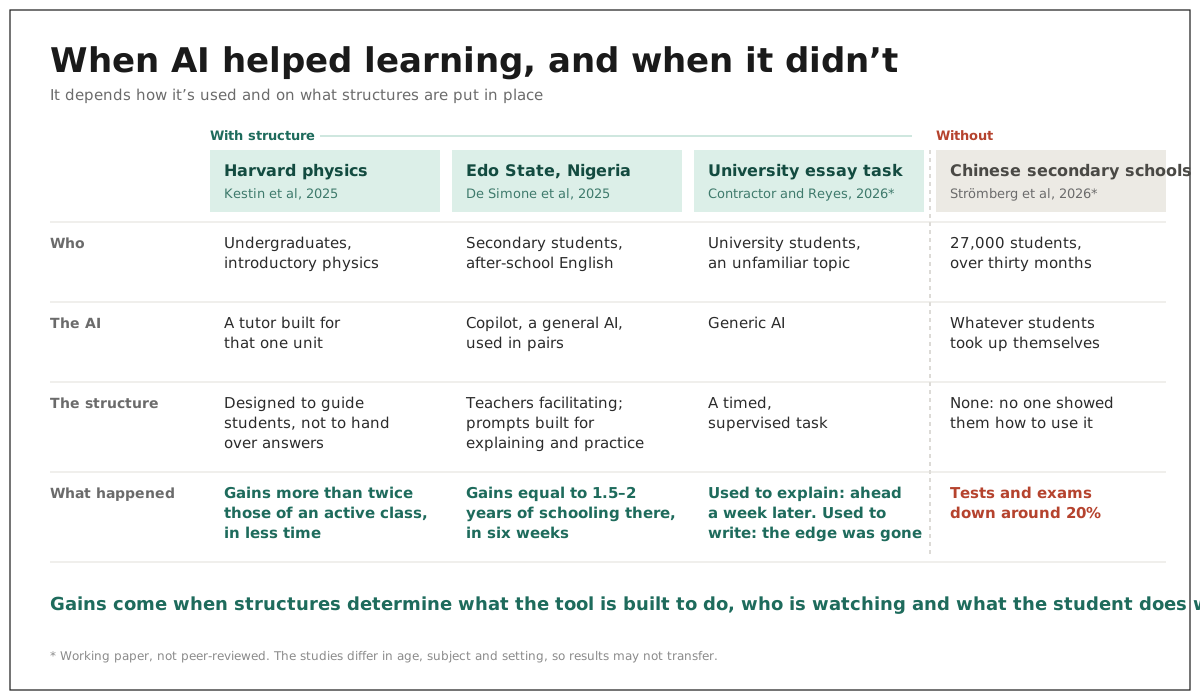
Associate Director of Science Education at Harvard, Greg Kestin, and colleagues ran a randomised trial in the university’s largest introductory physics course, which had been refined over many years in light of what we know about learning, so the sessions were active, not just a series of lectures. The trial was that one week, half the students learned from an AI tutor at home while the other half had the usual lesson in class. The following week, on a new topic, they swapped.
The tutor wasn’t a general chatbot – it was built around the course objectives and designed to guide students through the material rather than hand them answers, because, as the paper notes, “working with an expert personal tutor is generally regarded as the most efficient form of education. A tutor can guide the student while providing personalized feedback and answering questions as they arise”. So this is a far cry from unstructured use of general-purpose AI.
On subsequent assessment, and measured against what they knew beforehand, the students using the AI tutor improved more than twice as much as those in class, and in less time: 49 minutes against 60. And this wasn’t just memorisation: most of the test questions asked students to apply or analyse what they had learnt, not simply recall it. The gains held for both stronger and weaker students, and furthermore 83% of students said the AI tutor’s explanations were as good as, or better than, those from the (experienced) human instructors. And here is a telling detail – the few students who found the class pace too fast all spent more than the median time on the AI lesson, and the few who found it too slow all spent less. It’s a small group, but to me it’s one of the most encouraging aspects of this study: given the chance, these students seem to pace themselves according to what they need.
Yes, I know: it’s Harvard, it’s physics, and it’s undergraduates, and the paper has a whole raft of its own caveats, which I won’t list here. So we shouldn’t assume the findings transfer, because context matters, and how children learn changes a great deal with age.
So let’s turn to a very different setting – Edo State, Nigeria, where a World Bank team ran an after-school programme for secondary students learning English. Students worked in pairs with Copilot for six weeks, with teachers playing an active facilitation role throughout, and with prompts designed to support explanation, practice, and revision, rather than shortcuts.
Implementation was not smooth – there were frequent power and connectivity interruptions, but students’ English improved by about a quarter of a standard deviation; the researchers estimate that this is equivalent to one and a half to two years of normal schooling in those schools! Of particular interest is that “the benefits extended beyond the scope of the programme itself. Students who participated also performed better on their end-of-year curricular exams. These exams, part of the regular school programme, covered topics well beyond those addressed in the six-week intervention. This suggests that students who learned to engage effectively with AI may have leveraged these skills to explore and master other topics independently.” So in this case, there seem to have been benefits even though it was a general-purpose AI. What was common with the Harvard experiment was a structured approach and a focus on pedagogy, not just outcome.
The same features can be shown in the third (currently not peer-reviewed) case, where Contractor and Reyes randomly assigned university students to learn an unfamiliar topic and write an essay on it, with or without generic AI. All students were then immediately tested without the AI, and again a week later. The researchers report that the AI group: knew more in both cases; spent less time drafting and more time reading and searching; enjoyed the learning more. Importantly, students who had used AI to explain ideas to themselves were still ahead of the no-AI group on the tests a week later, whereas those who had used it to write for them lost their essay advantage over the no-AI group once the AI was taken away. On this basis, Contractor and Reyes argue that “these results provide proof of concept that off-the-shelf AI can improve learning, with outcomes that differ by how students choose to use it” (which is to say, that motivation is a critical factor, as I have argued here). They are also careful to add that this doesn’t mean widespread AI use will raise learning overall, because students may use AI to be more efficient and simply spend less time studying – so student behaviour and motivation are critical.
At a very different scale, 760,000 students, the OECD’s 2025 PISA results point the same way. Students who use AI for specific schoolwork tasks such as summarising or drafting score lower in science; but others whp have been taught about it at school tend to score slightly higher. This is correlation, not cause, and the OECD notes that such teaching is more common among advantaged students. But it is at least consistent with the rest: it depends how it’s used.
None of these gains came from simply giving students AI and stepping back. At Harvard and in Nigeria the structure came from teachers; in the Contractor study it came from a timed, supervised task, and even then what mattered was how students chose to use it. So this means that learning design, not tool adoption, is the thing. Without the right design, the tool is a danger. Benefits only come when there is structure around the tool: what it’s built to do, who’s watching, and what the student is asked to do with it. That is precisely the part that schools are for.
In school
I wish I could point to examples of our own showing effects like those above, but we don’t run randomised controlled trials (if only!). But we seek to be equally deliberate: our Heads of Digital Learning run sessions showing teachers what good use looks like, with planning frameworks and examples of what to do and what not to do – and then we trial, observe and iterate.
Two examples show the same idea at different ages: using AIs in ways that align with what supports learning..
In Grade 8 Geography, teachers redesigned a four-week inquiry by doing it themselves as students and deciding, stage by stage, where AI would help and where it would get in the way. Most of their decisions were about where it would not be used: students choose their own question, do their own early research, and write their own final answer by hand in class, all without it. Where they do use it, the chatbot the teachers built is told that “under no circumstances” is it to write for them or give them data.
In Grade 10 Psychology, students are taught to use Gemini as a research assistant rather than a research database. They ask it for directions, not facts: who the key researchers are, which studies are foundational, what terms to search for. Then they take those names and terms to JSTOR, and find, read and judge the actual, real papers themselves. That’s exactly the pattern in the Contractor and Reyes study: AI used to explain and point the way, with more time spent reading and searching. There is a check built in, too: if Gemini has invented an author or a study, as these tools sometimes do, JSTOR simply won’t have it.
The difference between the two is where the limits sit. In Grade 8 the teacher builds them into the tool; by Grade 10 students are using a general tool, and the limits are in how they have been taught to use it. That is the gradient I described in my first post.

So we’re trialling AI within agreed limits. We’re not trying to be groundbreaking; the ice may be too thin for that. The research is young, and we’d rather learn from the mistakes of the early adopters than be one ourselves. With all those caveats, I think it’s fair to say that the best-evidenced benefit of AI in schools is actually about teachers, not students.
In two high-quality trials, the Education Endowment Foundation found that using AI cut lesson planning time substantially. Secondary science teachers using ChatGPT spent 31% less time planning. Primary teachers using Oak National Academy’s lesson assistant spent 24% less, about 49 minutes a week. Critically, independent expert panels, judging blind, found no drop in the quality of the lesson resources. Our own teachers use AI in similar ways – for example, to embed our shared curriculum, to create differentiated resources, or to check new tasks against our assessment and feedback policy.
Now, saved time doesn’t by itself mean better teaching; it depends entirely on where the time goes. But it certainly opens up the possibility. And it could go to the work that only a teacher can do: our students told us that what would help them most was more check-ins, with someone asking them about their work in person. Time saved is time available. If every one of our 600 teachers spent an extra hour a week checking in with kids, that’s a lot of conversations over the course of the year (I suppose an extremely crude measure here is that 600 hours a week is equivalent to 10–15 teachers).
(The same goes for students, by the way. If AI lets students do the same learning in less time, that is no bad thing. They can take their studies further, give it to service, sports or music, or simply relax. We do want them to have a childhood.)
Now, having said I don’t want to be groundbreaking, let me test the ice just a little. Looking back at the examples, what strikes me is how much room there is for creativity – especially if there’s some extra time. Here’s one I came up with myself, after a few moments’ thought.
In Grade 6, students write a persuasive letter to the Head of Middle School, all in class – about something they see in the school that isn’t best for education; they have to explain what and why. They try their draft on a chatbot their teacher has built: it knows the rubric, asks questions, and never rewrites a sentence. They revise, and note what improved and what advice they ignored. The assessment comes a week later: a new persuasive letter on a different topic, written in class without the chatbot.
I’m not saying that’s the right design. But it occurs to me that if we stop seeing AI only as a threat and a cheating machine, we can start using it creatively, like this, as a tool. This one borrows straight from the research: the chatbot explains rather than writes, and the assessment checks what students can do without it. Will it be perfect? I doubt it – there is nothing perfect under heaven, as they say. Will it help a teacher be creative and enthusiastic, and take students somewhere new? I think so. Will it get better as it’s refined year after year? For sure. I think that’s all we can ask; and it’s a hopeful sign.
So as you can see, the most important decisions are about what the AI won’t do. A chatbot that cheerfully rewrites a paragraph is easy to build and close to useless, because the student learns nothing from it. One that knows the rubric, asks awkward questions and refuses to touch a single sentence is far more useful. I have no doubt whatsoever that it will also be more irritating to use – but that’s a feature, not a bug. The struggle stays with the student, where it belongs.
And once you start thinking this way, the ideas come quite quickly. A history chatbot that plays a sceptical examiner and won’t accept any claim without evidence. A Spanish conversation partner that is endlessly patient, and will discuss most (not all) topics the student is interested in. A deliberately mediocre essay written by AI, handed to students to mark and improve, so they learn to argue with a machine rather than defer to it. Some of these would work and some wouldn’t – but there’s only one way to find out which ones are which.
At home
In the last post I suggested some questions that make work visible: what did you find hard, what did you leave out, explain that bit to me. The Contractor study adds one more, and it’s simple enough to use over dinner: Did the AI explain something to you, or did it make something for you? And there is an obvious follow-up. If it explained, what did it help you understand?
A child who can answer that has probably used the tool the way the research recommends. A child who can’t may have handed the thinking over.

So, as far as AI and kids goes, the evidence points one way: structure, not software. Which is to say, the tool matters less than the teaching. While the most impressive single result came from a tutor built for one specific unit, the general-purpose AI studies still found gains, and that shouldn’t surprise anyone: pedagogy has always mattered more than tools, and AI looks to be no exception.
None of this, by the way, is entirely new: researchers were studying AI tools built to support learning well before ChatGPT. A recent review of 35 such studies, going back to 2013, reaches much the same conclusion: the effects depend heavily on how the tools are designed. People have said AI is different to previous technologies, and in one way it is: it makes it easier than ever to skip the thinking. But what makes it work is what has always made teaching work.
Some of our teachers are building simple chatbots for particular lessons, but nothing on the scale of Harvard’s tutor, whose platform took months to develop and was tested in a controlled trial. Most of what we use is more general than that. So we’re building in the direction the evidence points, but we’re cautious and careful. Much of the research is new, some of it isn’t yet peer-reviewed, and the tools are changing faster than the studies (and we) can keep up. We’ll keep reading it, and we’ll keep telling you what we find.
With thanks to Ellie Alchin, Angela Newby, Tim Lovatt and Gemma Dawson for the conversations that led to this series.
References
- Graphics by Claude and Gemini
- Contractor, Zara and Reyes, Germán (2026) Experimental Evidence on the Learning Impact of Generative AI, arXiv:2607.08849 (preprint; not peer-reviewed)
- De Simone, Martín, Tiberti, Federico, Barron Rodriguez, Maria, Manolio, Federico, Mosuro, Wuraola and Dikoru, Eliot Jolomi (2025) From Chalkboards to Chatbots: Evaluating the Impact of Generative AI on Learning Outcomes in Nigeria, World Bank Policy Research Working Paper 11125
- Education Endowment Foundation / NFER (2024) Teachers using ChatGPT – alongside a guide to support them to use it effectively – can cut lesson planning time by over 30 per cent, Teacher Choices trial
- Education Endowment Foundation / NFER (2026) Lesson planning using AI lesson assistant, Aila – A Teacher Choices Trial, published 6 October 2026
- Kestin, Greg, Miller, Kelly, Klales, Anna, Milbourne, Timothy and Ponti, Gregorio (2025) AI tutoring outperforms in-class active learning: an RCT introducing a novel research-based design in an authentic educational setting, Scientific Reports, 15, 17458
- OECD (2026) PISA 2025 Results (Volume I): Future-Ready Students
- Strömberg, David, Lei, Victor and Wu, Yanhui (2026) The Generative AI Learning Penalty: Evidence from Chinese Secondary Education, CEPR Discussion Paper No. 21577, CEPR Press (working paper; not peer-reviewed)
- Xu, Jun, Luo, Yuying, Wang, Chengliang, Wang, Mengji and Wu, Yonghe (2026) AI support in self-regulated learning: A decade of technological evolution and meta-analysis, British Journal of Educational Technology, 57(5), 1191–1220